AUSTRALIA'S ORIGINAL AND BEST CAMP OVEN AND OUTDOOR COOKING AND CAMPING FORUM
https://www.aussiecampovenforum.com/cgi-bin/yabb2/YaBB.pl
Camp Oven & Outdoor Cooking >> Camp Ovens & Related Equipment >> Rusty camp oven
https://www.aussiecampovenforum.com/cgi-bin/yabb2/YaBB.pl?num=1201225886

Message started by voiletmay on Jan 25th, 2008 at 11:51am

Title: Rusty camp oven
Post by voiletmay on Jan 25th, 2008 at 11:51am
Hi Everyone

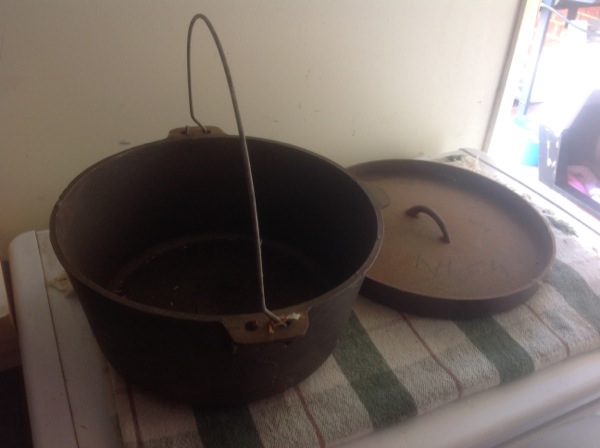
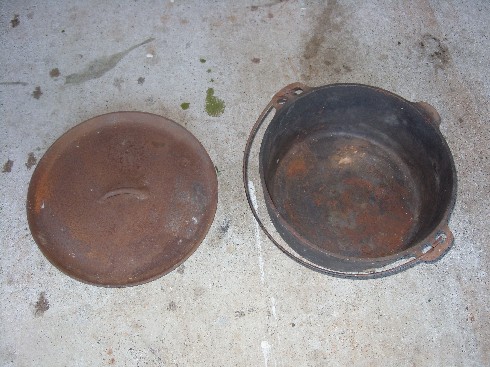
My mum gave me her old camp oven today.  She bought it from a disposal store in Morwell, Victoria in about 1975.    When I was a child she would use the lid upsidedown on a gas burner to make chaptitis (indian bread, she got inspired by reading a book she got free from the Hare Krishnas LOL).  She never used the base at all.

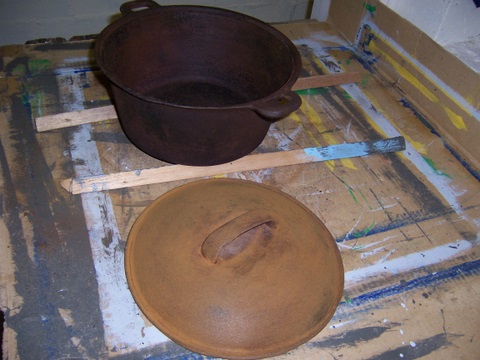
It is quite rusty, even the top of the lid which was exposed to a lot of fire over the years.  Just wanted to know what I could do about the rust.  I've got a big wire brush and my husband said about attaching a wire brush attachment to a drill.

Just need some advice about cleaning it, and whether it is worth doing or not? I realize if I don't fix it now, it will just get worse.

Was just in Anaconda earlier today and those cheap spinifex camp ovens were lovely, legs and everything, cute shape, even 30% off the price if you are an anaconda member.  I really wish I had waited and bought a 4.5 quart one of those instead of my legless one.  

Anyway here is the first photo of my mums camp oven with the rust:

campoven1.JPG (46 KB | )

Title: Re: Rusty camp oven
Post by voiletmay on Jan 25th, 2008 at 11:51am
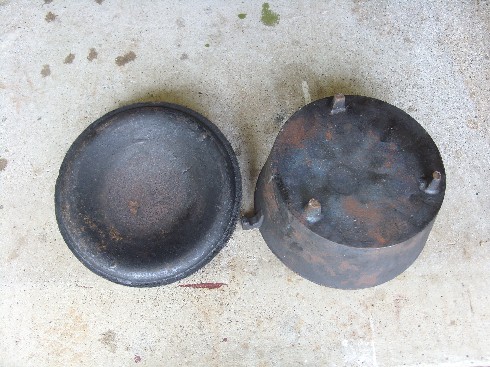
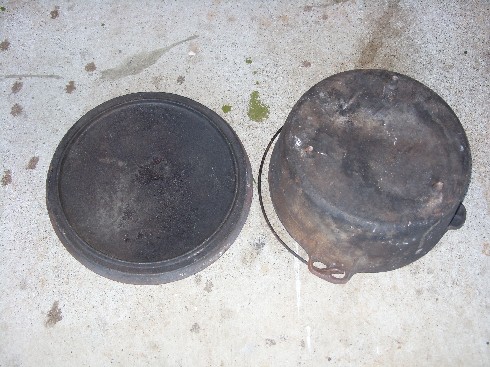
Underside of both pieces.
campoven2.JPG (70 KB | )

Title: Re: Rusty camp oven
Post by Mackerel Whisperer on Jan 25th, 2008 at 12:28pm
Hi voiletmay,

looks to me like it's not in to bad of a condition, I would just heat it up an give it a good oil, cook a few roasts' and it'll be like brand new. The top of the lid might need a hit with the wire brush though.

Regards

Jono

"Mackerel Whisperer"

Title: Re: Rusty camp oven
Post by Derek Bullock on Jan 25th, 2008 at 12:53pm

Wow that looks like an antique to me.  Very nice.

To remove the rust off the inside soak in 50/50 water and cider vinegar.  Not sure for how long, depends on the rust.  The outside you could use a wire brush.

Look after it thats a very nice old camp oven


Derek

Title: Re: Rusty camp oven
Post by Crazy_Dog on Jan 25th, 2008 at 1:23pm
Changed my mind - check the link on my next post - sorry folks...

Grrr!!!

Title: Re: Rusty camp oven
Post by Crazy_Dog on Jan 25th, 2008 at 1:27pm
Bugger - try the whole link fer ya selves---This all too bloody hard....


http://www.htpaa.org.au/article-electro.php

Grrr!!!

Title: Re: Rusty camp oven
Post by Furphyslinger on Jan 25th, 2008 at 1:28pm
cd
nothing attached

Title: Re: Rusty camp oven
Post by Crazy_Dog on Jan 25th, 2008 at 1:46pm
Mate I bin avvin' probs chopping it up .. Gave up and put the link up...see above.


Grrr!!!

Title: Re: Rusty camp oven
Post by poddy dodger on Jan 25th, 2008 at 2:29pm
Sorry violetmay, as an authority on camp ovens I can tell you it's way past fixing up. I have a hospice for old worn out camp ovens so send it to me ASAP.

Seriously, a good going over with a wire wheel in an electric drill then season it and it'll be as good as new..... nice little pot !

pd

Title: Re: Rusty camp oven
Post by Crazy_Dog on Jan 25th, 2008 at 5:18pm
Yep that's the best and easiest...

Grrr!!!

Title: Re: Rusty camp oven
Post by voiletmay on Jan 25th, 2008 at 6:15pm
Thanks for the replies and suggestions everyone.  Poddy Doger you made me laugh LOL!!

I wire brushed it, and then rubbed it it vinegar and water, then dried it, rubbed it with oil, then baked it for an hour or two.  It is still cooling.  I'll get a photo tomorrow when it is able to be handled.

The lid was in the worst condition out of the two pieces.  I used a scredriver and scraped a lot away using it.

My mum will be pleased to hear that you think her camp oven is nice and an antique LOL!!

Thanks for that article too, was an interesting read.

Oh I definately think I will be able to cook in it now, which is good.

Title: Re: Rusty camp oven
Post by Little_Kopit on Jan 25th, 2008 at 7:39pm
You can also get a bail made for it.  The bail is the wire handle attached to those ears at the sides of the pot.   Stainless steel wire about 1/8" or 3 - 4 mm thick.  Find a handy soul or find good metal shop.    It needs to be made with  a big enough loop to lie on its side when the lid is on and leave you with nothing in the way of your lifting the lid off while it's baking.


:-/

Title: Re: Rusty camp oven
Post by voiletmay on Jan 26th, 2008 at 3:44pm
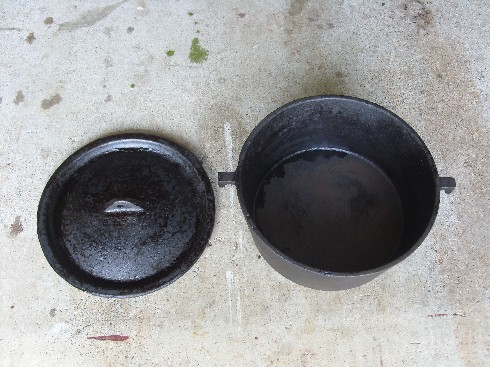
Thanks for the info about the bail.  Ok here are the after photos.  Sorry, I don't know how to put more than one photo at a time on a mesage.
fixedtop.JPG (69 KB | )

Title: Re: Rusty camp oven
Post by voiletmay on Jan 26th, 2008 at 3:44pm
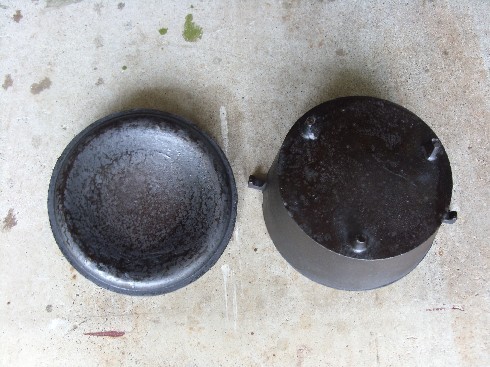
Next one...

But wait there's more...
fixedunder.JPG (63 KB | )

Title: Re: Rusty camp oven
Post by voiletmay on Jan 26th, 2008 at 3:55pm
Ok.. another day another old campoven.  I was talking to my friend on the phone (she is a retired geologist) and she said I could have her camp oven.  

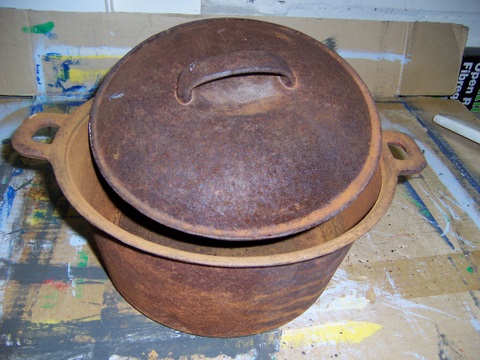
The lid is the only really bad rust area, but seems quite light rust compared to the lid on my mums campoven.  It is 12 inches across and has tiny little legs which seem to small to be useful.  She says she bought it in Brisbane in about 1987.  So not as old as my mothers, and I think you can tell that a bit by how it looks, it looks more like my new one than my  mums older one.

I'm not sure if I want to fix it.. it reminds me of my friend and her years as a field geologist, she has been talking lately of needing to move into a unit and about going into a nursing home (in Victoria where her son is, we are in Brisbane now).  Very sad, I think I want it left the way it is to remind me of her.  Anyway, I will think about it a bit more before I attempt to clean it.
jennytop.JPG (65 KB | )

Title: Re: Rusty camp oven
Post by voiletmay on Jan 26th, 2008 at 3:56pm
Under side of new rusty camp oven.
jennyunder.JPG (69 KB | )

Title: Re: Rusty camp oven
Post by Derek Bullock on Jan 26th, 2008 at 4:00pm

You did a really good job on that Violet.  Very good in fact.

With the other one, if you don't remove the rust it can only deteriorate more so I would if I was you.


Derek

Title: Re: Rusty camp oven
Post by Derek Bullock on Jan 26th, 2008 at 5:50pm
I think this is the same brand as Violet's old one

http://cgi.ebay.com.au/Vintage-Cast-Iron-Camp-Pot_W0QQitemZ180209212235QQihZ008QQcategoryZ20087QQssPageNameZWDVWQQrdZ1QQcmdZViewItem


Title: Re: Rusty camp oven
Post by Thenewme on Feb 1st, 2008 at 7:31pm
Hi Crazy Dog,

Correct me if I am wrong,

If I have a battery charger and I attach the red lead to some metal (do not submerge the red clamp) attach the black clamp to the rusty item (this clamp can be submerged) throw it in a large plastic container of solution being 10 grams of washing soda to a litre of water or 1 teaspoon to 1 pint of water (Allow the crystals to desolve prior to chucking in whatever).

Now is that about it, can I start unscrewing those funny little clamps that hold our poptop caravan roof down (they are the only scabby looking things on our van due to being a bit rusty)

Is that how it works.

Wonder what hubby is going to say when I start using his battery charger.


Cheers
Kate

Title: Re: Rusty camp oven
Post by Crazy_Dog on Feb 1st, 2008 at 9:55pm
Yup!!!


Grrr!!!

Title: Re: Rusty camp oven
Post by murray on Feb 2nd, 2008 at 5:28am
Hey CD
Thanks for the tip on rust removal, I have a few things I will try it on.
Muzz

Title: Re: Rusty camp oven
Post by Little_Kopit on Feb 2nd, 2008 at 5:39am
Has the self cleaning oven been mentioned yet?  I have seen it mentioned that if you have a self cleaning oven and you run it on that cycle, it will loosen all the rust.  All you do after it has cooled is have the vacuum cleaner right there when you open the oven door.

:-/


Title: Re: Rusty camp oven
Post by Carolyn™ on Feb 2nd, 2008 at 6:43am
Wow Voilet your collection is off to a good start.  I am most envious.

Have put out some feelers here and hopeful that some pre loved ones might start appearing  :D

Fair bit of competition in this area   ;) ;)

Title: Re: Rusty camp oven
Post by Thenewme on Feb 2nd, 2008 at 3:52pm
Hi CD,

Looks like the worst half is going to lose his battery charger and now have a different opinion on rusty camp ovens.

Cheers and thanks again MD

Kate

Title: Re: Rusty camp oven
Post by Furphyslinger on Feb 2nd, 2008 at 5:00pm
The Electrolytic Method
The electrolytic method is a cheap, gentle and effective method which causes minimal alteration to the metal surface. It may seem complex, but is actually easy to set up and use. It is quite safe, provided certain sensible precautions are taken (see below). The electrolytic method involves immersing the rusty object in an electrically-conducting solution of washing soda (sodium carbonate). The negative lead (black) from a battery charger is attached to the object, and the positive (red)lead is attached to a stee1 electrode dipping into the solution. When the current is turned on, electrochemical reduction reactions occur at the metal/oxide interface on the object's surface. These reductions loosen the rust layer, allowing it to be easily brushed off. These reactions may involve the direct reduction of iron oxides to finely divided iron. However, it is clear from observation that a major reaction at the negative electrode involves the production of thousands of tiny bubbles of hydrogen from the electrochemical reduction of water. The hydrogen may in turn react chemically with the iron oxides, or it may simply act to physically dislodge the rust layer. Whatever the mechanism, the process does not appear to cause etching or deposition on the metal surface. Of course, removal of rust will reveal any damage to the surface (such as pitting) which has already occurred.

Important Safety Precautions
1. Since pure water is a poor conductor of electricity, a soluble salt, (called an electrolyte) has to be added to make an electrically conducting solution. The best salt to use is sodium carbonate (washing soda). A packet can be bought in supermarkets for a few dollars. Washing soda solutions are alkaline and will irritate the skin and (especially) the eyes. Always use eye protection and gloves and wash off any spills immediately. Do not try to use other salts - no better results will be obtained and dangerous effects may occur. Caustic soda, for example, is far too corrosive, and even strong solutions of ordinary table salt will generate toxic chlorine gas at the positive electrode.

2. The battery charger is attached to the mains and must be completely shielded from the solutions which conduct electricity. Make sure no spills can touch the battery charger - especially when it is unattended. The 6/12 volt leads from the charger are relatively safe, but you may still get an unpleasant shock if you put your hands in the solution or touch the electrodes while the current is running. Turn off the current before making adjustments to the electrolysis bath.

3. A major reaction occurring in the bath is the splitting of water into hydrogen gas (at the negative electrode) and oxygen at the positive electrode). Hydrogen will combine explosively with oxygen or air if ignited. (Remember the Hindenburg!) All flames (including cigarettes) must be removed from the area, and sparks caused by touching the leads together must be avoided. The work should be well ventilated to dilute and remove these gases safely. Do not use this method in a confined, poorly ventilated area.

Preparation of the Electrolyte Solution
A sufficient concentration of washing soda is about 10 gram/litre (about 1 teaspoon per pint). The concentration may be increased somewhat but the results will not change greatly. Make sure all the crystals have dissolved before using the solution.

The Electrolytic Bath


De-rusting of small pick head by electrolysis

The simplest variant of this method requires a non conducting inert plastic container (plastic dish, box, bath, bin etc.). Some ingenuity is needed to find containers deep or long enough for items such as long saw blades or leg vices. After removing any wooden handles, brass fittings, etc. from the object, sufficient washing soda solution is added to completely submerge it.
A stainless steel strip is recommended for the positive electrode or anode (e.g. a piece about 2-3" wide and long enough to emerge from the solution). Ordinary scrap iron or steel can be used, but the surface will quickly clog up with corrosion. Do not use copper or other metals, as these will be rapidly eaten away.
The reactions at the anode involve the production of bubbles of oxygen gas from oxidation of water, plus the direct oxidation of the metal electrode. Stainless steel is most resistant to the latter process, but even it may show some minor pitting after a while. The anode should be brushed clean at intervals. The red lead from the battery charger should be clipped to the anode where it emerges from the solution. If this attachment clip dips under the surface, it will be eaten away. The negative lead (black) is attached to the rusty object. In this case, the attachment clip may be submerged under the solution - corrosion does not occur at the negative electrode (cathode). It is very important to have good contact at the attachment point, so these should be cleaned by wire brush or emery paper. The object and the positive electrode should be separated by at least a few inches. If they are allowed to touch, a short circuit will occur and the battery charger may be damaged.

The Battery Charger
Any 6 or 12-volt battery charger will work, provided it can produce a few amps of direct (DC) current. A current of about two amps at 12 volts is typical (a charger with a current meter is useful as it shows you what is happening). If several objects are attached in parallel, or a very large object is attached, the current may rise. Be careful not to exceed the capacity of your charger. The current may be reduced by increasing the separation between the object and the anode or by diluting the solution with water. A car battery would also work as a DC power source.

The Process


Hydrogen bubbles forming on the object's surface during electrolysis  

Once the circuit is completed, tiny bubbles will stream from both electrodes. The time required for effective de-rusting will vary from 30 minutes for small objects (such as auger bits) to many hours for large objects such as a leg vice. Overnight operation is common. No harm is done by leaving the circuit on for long periods, as long as the charger does not overheat or gases do not build up in an unventilated area. After a time the object should be rotated to avoid "shadow" effects (uneven de-rusting). If part of the objet has been left projecting above the solution, the object should also be inverted to de-rust the exposed part. As time passes, some of the rust will fall off and sink to the bottom of the container. When enough time has elapsed (learned mainly by experience), turn off the charger, remove the object from the bath and rinse off the electrolyte with water.

The residual rust will now appear as a dark surface sludge which can be easily removed with a hand wire brush or plastic scourer. This is less messy when done under water (e.g. in a water-filled bucket). After rinsing and thorough drying, the object will now appear free of red rust, but there may still be a thin layer of closely-adherent black oxide.

For certain antique artifacts, this grey-black appearance may be quite attractive. However, brief power brushing will quickly remove this thin layer and give a progressively shiny and burnished appearance (appropriate for items such as plane blades).


Rust sludge remains on object surface after electrolysis


Clean steel surface after sludge has been brushed off


Baking in an oven for an hour or two at about 150°C (300°F) is an option which will give the objects an attractive bronze-yellow patina, deter further rusting and protect against hydrogen embrittlement (see below). Alternatively a rust inhibitor such as RP-7 may be applied, or the object simply oiled or waxed to deter future rusting. If only part of the objet was submerged there will usually be a faint "tidal mark" where the object emerged from the solution. This is one reason to seek containers large enough to submerge the whole object at once. I find that intact japanning is not usually damaged by electrolysis, but loose paint of any type will be stripped off and this is often a useful feature of the method.

The method works best on objects that are electrically well-connected. Ideal objects for de-rusting by this method include augurs, axe heads, saws, single bow hand shears, plane bodies, cast iron pots etc. Whenever the object has multiple parts, the electrical contact between the parts will affect the results obtained. If the contact points are coated with rust, dirt or grease, little current will flow from one part to the next and de-rusting may be slow. If only a few parts are involved, it is easy to connect each part separately by providing several branches from the negative lead or use short leads to connect each part to the next using clean contact points.

Other Variants of the Electrolytic Method
1. The bath itself may be made of stainless steel and used as the anode (positive electrode while the rusty object is suspended in the middle of the solution without touching the container. This method maximizes the size of the anode and allows current to flow to the object from all directions - thus minimizing shadowing effects.

2. The opposite of the above. Hollow vessels such as iron pots are filled with the electrolyte solution and attached to the negative lead, while the anode is suspended in the middle of the solution. This allows excellent de-rusting of the inside of such pots. A similar method has been used to remove rusty encrustations from the inside of cannons found in sunken ships.


De-rusting the inside of an iron pot using a suspended anode  

3. Small items may be placed on a stainless steel grid suspended in the solution and electrically connected to the negative (black) lead. The rusty items make electrical contact with the grid and do not need to be individually connected to the lead. However the de -rusting w

Title: Re: Rusty camp oven
Post by Furphyslinger on Feb 2nd, 2008 at 5:02pm
Preparation of the Electrolyte Solution
A sufficient concentration of washing soda is about 10 gram/litre (about 1 teaspoon per pint). The concentration may be increased somewhat but the results will not change greatly. Make sure all the crystals have dissolved before using the solution.

The Electrolytic Bath


De-rusting of small pick head by electrolysis

The simplest variant of this method requires a non conducting inert plastic container (plastic dish, box, bath, bin etc.). Some ingenuity is needed to find containers deep or long enough for items such as long saw blades or leg vices. After removing any wooden handles, brass fittings, etc. from the object, sufficient washing soda solution is added to completely submerge it.
A stainless steel strip is recommended for the positive electrode or anode (e.g. a piece about 2-3" wide and long enough to emerge from the solution). Ordinary scrap iron or steel can be used, but the surface will quickly clog up with corrosion. Do not use copper or other metals, as these will be rapidly eaten away.
The reactions at the anode involve the production of bubbles of oxygen gas from oxidation of water, plus the direct oxidation of the metal electrode. Stainless steel is most resistant to the latter process, but even it may show some minor pitting after a while. The anode should be brushed clean at intervals. The red lead from the battery charger should be clipped to the anode where it emerges from the solution. If this attachment clip dips under the surface, it will be eaten away. The negative lead (black) is attached to the rusty object. In this case, the attachment clip may be submerged under the solution - corrosion does not occur at the negative electrode (cathode). It is very important to have good contact at the attachment point, so these should be cleaned by wire brush or emery paper. The object and the positive electrode should be separated by at least a few inches. If they are allowed to touch, a short circuit will occur and the battery charger may be damaged.

The Battery Charger
Any 6 or 12-volt battery charger will work, provided it can produce a few amps of direct (DC) current. A current of about two amps at 12 volts is typical (a charger with a current meter is useful as it shows you what is happening). If several objects are attached in parallel, or a very large object is attached, the current may rise. Be careful not to exceed the capacity of your charger. The current may be reduced by increasing the separation between the object and the anode or by diluting the solution with water. A car battery would also work as a DC power source.

The Process


Hydrogen bubbles forming on the object's surface during electrolysis  

Once the circuit is completed, tiny bubbles will stream from both electrodes. The time required for effective de-rusting will vary from 30 minutes for small objects (such as auger bits) to many hours for large objects such as a leg vice. Overnight operation is common. No harm is done by leaving the circuit on for long periods, as long as the charger does not overheat or gases do not build up in an unventilated area. After a time the object should be rotated to avoid "shadow" effects (uneven de-rusting). If part of the objet has been left projecting above the solution, the object should also be inverted to de-rust the exposed part. As time passes, some of the rust will fall off and sink to the bottom of the container. When enough time has elapsed (learned mainly by experience), turn off the charger, remove the object from the bath and rinse off the electrolyte with water.

The residual rust will now appear as a dark surface sludge which can be easily removed with a hand wire brush or plastic scourer. This is less messy when done under water (e.g. in a water-filled bucket). After rinsing and thorough drying, the object will now appear free of red rust, but there may still be a thin layer of closely-adherent black oxide.

For certain antique artifacts, this grey-black appearance may be quite attractive. However, brief power brushing will quickly remove this thin layer and give a progressively shiny and burnished appearance (appropriate for items such as plane blades).


Rust sludge remains on object surface after electrolysis


Clean steel surface after sludge has been brushed off


Baking in an oven for an hour or two at about 150°C (300°F) is an option which will give the objects an attractive bronze-yellow patina, deter further rusting and protect against hydrogen embrittlement (see below). Alternatively a rust inhibitor such as RP-7 may be applied, or the object simply oiled or waxed to deter future rusting. If only part of the objet was submerged there will usually be a faint "tidal mark" where the object emerged from the solution. This is one reason to seek containers large enough to submerge the whole object at once. I find that intact japanning is not usually damaged by electrolysis, but loose paint of any type will be stripped off and this is often a useful feature of the method.

The method works best on objects that are electrically well-connected. Ideal objects for de-rusting by this method include augurs, axe heads, saws, single bow hand shears, plane bodies, cast iron pots etc. Whenever the object has multiple parts, the electrical contact between the parts will affect the results obtained. If the contact points are coated with rust, dirt or grease, little current will flow from one part to the next and de-rusting may be slow. If only a few parts are involved, it is easy to connect each part separately by providing several branches from the negative lead or use short leads to connect each part to the next using clean contact points.

Other Variants of the Electrolytic Method
1. The bath itself may be made of stainless steel and used as the anode (positive electrode while the rusty object is suspended in the middle of the solution without touching the container. This method maximizes the size of the anode and allows current to flow to the object from all directions - thus minimizing shadowing effects.

2. The opposite of the above. Hollow vessels such as iron pots are filled with the electrolyte solution and attached to the negative lead, while the anode is suspended in the middle of the solution. This allows excellent de-rusting of the inside of such pots. A similar method has been used to remove rusty encrustations from the inside of cannons found in sunken ships.


De-rusting the inside of an iron pot using a suspended anode  

3. Small items may be placed on a stainless steel grid suspended in the solution and electrically connected to the negative (black) lead. The rusty items make electrical contact with the grid and do not need to be individually connected to the lead. However the de -rusting will proceed rather slowly unless the items have been cleaned where they touch the grid. Small chains and other intricate objects with connected parts may be de-rusted using this technique.


Localised de-rusting of the sole of an infill plane using an electrolyte-soaked sponge


4. To avoid immersion of objects such as wood-infill planes the bath may be replaced by a solution-soaked sponge or cloth which lies between the object and a stainless steel plate which acts as the positive electrode. The negative lead is attached to the object and current flows only through the soaked sponge. Be careful to avoid any short circuits. More solution should he added to the sponge periodically as it heats up and tends to dry out. This method can be used to de-rust small parts of artefact quite precisely without wetting the whole object.


Hydrogen Embrittlement of Steel - A Cautionary Note
Atoms of hydrogen absorbed by steel are known to enter the lattice of iron atoms and prevent the layers from sliding past each other easily. This causes the steel to become more brittle and liable to crack. The absorption of hydrogen by steel is a familiar problem in industry which arises during steel refining, heat treatment, acid pickling or electro-plating. It can also happen as a result of simple corrosion. The standard remedy is to bake the objects in ovens to drive out the absorbed hydrogen (200°C for four hours would be a typical regime in industry). The simple passage of time is also known to cause loss of hydrogen from steel. Hydrogen embrittlement may occur to some extent during electrolytic de-rusting. This may be a cause for concern with saws or other edge tools. It might be wise to wait a while before setting saw teeth after prolonged, electrolytic de-rusting. Alternatively, baking the tool in the oven for hour or so at about 150°C (300° F) should remove absorbed hydrogen. Note that this baking temperatures is low enough to leave the temper of most steels unaffected. Since hydrogen embrittlement is reversible, it should not cause too much anxiety. I believe that the advantages offered by electrolytic de-rusting justify wider experimentation by tool collectors. As more experience is gained clearer knowledge of its advantages and disadvantages will emerge.

Problems with Stainless Steel Anodes


Some thoughtful correspondents have pointed out that the use of stainless steel for the positive electrode (anode) may have some undesirable consequences. Most stainless steels contain high percentages of chromium and nickel which may be released into the bath as the anode is slowly eaten away. These are likely to be released initially as soluble cations just as the iron is released initially as ferrous ions. However, since all three cations are being released into an alkaline solution, they are likely to be immediately converted to insoluble hydroxides or oxides and form encrustations on the electrode or fall to the bottom as sediments. In this bound form the nickel and chromium are likely to be less hazardous but nevertheless waterproof gloves should always be worn when working with t

Title: Re: Rusty camp oven
Post by murray on Feb 25th, 2008 at 8:05am
Electolytic Rust Removal
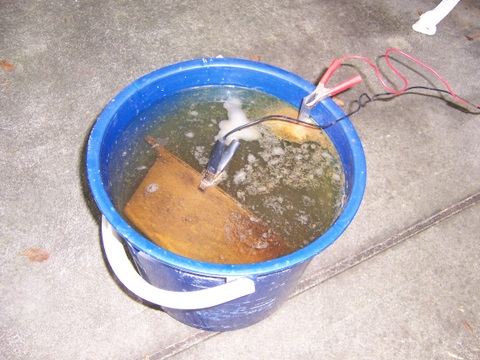
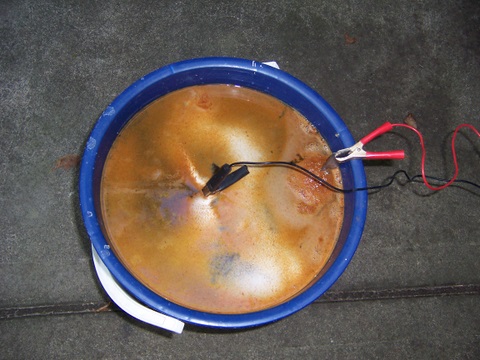
Had a go at this yesterday with pleasing results..top job..followed Crazy Dogs and Furphys post on the subject..gave the oven a sand with emery paper first... mixed the brine as per instructions.. I used a stainless steel ruler on the positve side it is now bugged..as you can see cleaned it very good... two hrs in the brine
100_0702-3.jpg (80 KB | )

Title: Re: Rusty camp oven
Post by murray on Feb 25th, 2008 at 8:07am
The brine
100_0706-1.jpg (85 KB | )

Title: Re: Rusty camp oven
Post by murray on Feb 25th, 2008 at 8:08am
After 1.5 hrs
100_0707-1.jpg (76 KB | )

Title: Re: Rusty camp oven
Post by murray on Feb 25th, 2008 at 8:09am
And the end result with the lid to be done
100_0708-1.jpg (68 KB | )

Title: Re: Rusty camp oven
Post by Derek Bullock on Feb 25th, 2008 at 9:06am

Pretty good Muzz.  Did you put anything on the ruler or just sit it in the water.  Also what amps is your charger.


Derek

Title: Re: Rusty camp oven
Post by murray on Feb 25th, 2008 at 10:44am
Derek
I just put the ruler in...make sure the clamp is not submerged.
The brine 1 X teaspoon washing soda per 600 mls water... mix well.
My battery charger is 8 amp... when it was in the brine it showed on the amp meter as 1  3/4 amps...I will see if I can get a bit of stainless steel to suit the job. I did not do this inside..as there is a slight gas given off... Very easy to do.. but like anything, tried for the first time I showed a little caution.....keep rug rats and pets away.

Title: Re: Rusty camp oven
Post by Derek Bullock on Feb 25th, 2008 at 11:11am

Thanks.  When I get to Brissy I am going to set something up myself.  I think this would be great for all our camp ovens after a bit of work just to clean them up before re-seasoning them.


Derek

Title: Re: Rusty camp oven
Post by Little_Kopit on Feb 25th, 2008 at 11:58am
Derek, going off topic, but given that your moving and I'm moving.  

I don't know what you're doing about appliances, but it costs lots of $ to move them.  & by comparison the energy efficiency of the new ones will save me lots of $.  I'm not sure I'm even going to move my old vacuum cleaner.  

Several have told me that a self cleaning oven loosens everything from cast iron.  & all you do after you have run the cycle is to have the vacuum cleaner beside you when you open up the cooled oven.  Of course, that will be my choice in stoves.  With the cast iron I have it wins hands down.  

& even if you have appliances where you're moving, I think it would pay to check how much electricity they use vs. the newer ones.

:-/

Title: Re: Rusty camp oven
Post by Derek Bullock on Feb 26th, 2008 at 11:53am

Appliances like stoves in Aussie are generally a fixture in houses and not moved.  I will only be renting for a while until I can get established and then will be getting a gas stove.  Most suburbs these days have natural gas piped in.

I have read about the self cleaning ovens but never seen them over here.  I believe they have a very high temperature setting for it where they simply just burn everything away.  Is that right.


Derek

Title: Re: Rusty camp oven
Post by Little_Kopit on Feb 26th, 2008 at 7:30pm
Yes, so I understand, the cycle goes up to 800' F.

8-)

Title: Re: Rusty camp oven
Post by Derek Bullock on Feb 26th, 2008 at 8:15pm
Imagine how much power that sucker would draw

Title: Re: Rusty camp oven
Post by Little_Kopit on Feb 26th, 2008 at 9:42pm
Compare with other stuff for energy.

Remember, these are energy efficient applainces.  There is a huge difference.

:-/

Title: Re: Rusty camp oven
Post by Scouter_Wayne on Feb 27th, 2008 at 12:34am

wrote on Feb 26th, 2008 at 11:53am:
 I believe they have a very high temperature setting for it where they simply just burn everything away.  Is that right.


Derek


I just thought I would add my 2 cents worth.  I have cleaned a camp oven in a self cleaning oven and it works great.  It does stink and the misses gets a little cranky.  The oven came out great, reseasoned great.

Wayne

AUSTRALIA'S ORIGINAL AND BEST CAMP OVEN AND OUTDOOR COOKING AND CAMPING FORUM Powered by YaBB 2.5 AE!
YaBB Forum Software © 2000-2026. All Rights Reserved.